This is another of my old friends from the late 70’s. 37054 was a March (MR) engine as modelled, but it did spend some time at Stratford (SF) as well.
This is a light to medium rendition of the Loco in what I would call its heyday. I have subtly highlighted the boiler and safety valves as per the below photos.
This batch of wagons are very different and the approach to weathering is also diverse.
Firstly the dear old 16T Mineral wagon – I have weathered many tens of these wagons and most have been grey – this one is of the brown, fitted example. Matt Black is the base wash and wipe colour and three tones of rust were used.
The next wagon is a Catfish Ballast Wagon, the wash and wipe on this wagon was a light grey. The inside of the hopper also had a little light rust added before being filled with O Gauge Ballast. The Ballast is left for an hour and then emptied out to give the desired effect. I look on this method as only reproducing what happens in the real world!
Lastly we have an OAA Open Wagon in Bauxite. After adding the door chains to the sides, these were painted medium rust. I then used a very dark brown to do the wash and wipe with.
Finally the photo below shows the diverse wash and wipe used.
A pair of my old friends from the late 70’s. A Dapol O8 re-numbered as O8250 a NR (Norwich) Engine and a Heljan O3 as O3175 a MR (March) Engine. Both are Vacuum braked examples.
Both are medium weathered and are DCC Fitted. Special attention has been paid to bonnet hinges with a little rust of the O8 hinges. The wipe and wash method used again to make the engines look 3D rather than coloured plastic.
Here we have a pair of Dapol standard 12T Vans, my only brief was for a light – medium weathering. Not too complicated at all, one van being planked and the other plywood sides.
The key to weathering these wagons is the wash and wipe method and getting shadow into every crevice, before airbrush weathering. A few old chalk markings are added to pull everything together.
The Roof on each van has been stippled with a piece of foam dipped in dilute matt black.
No not a famous brand of liquid refreshment – a proper Coke challenge. Last time I met my friend Mike he presented me with two Private Owner Coke wagons from the late 1940’s. They were an eight plank SUNCOLE in the black house colours and a seven plank in CRANSLEY COKE in their very vivid reddy-pink livery.
My challenge was to bring them forward in time about twenty years. Mike wanted them in slightly different new liveries – he had already researched the prototype wagons and gave me some sample wagon numbers.
I attacked the eight plank first and started to remove the original SUNCOLE livery. However I wanted to leave enough original paint so that after repainting BR grey, it would show through to show its ancestry and the indifferent BR paint Job! I also chipped some paintwork to make it even more distressed.
I then started the CRANSLEY COKE the same way, only this time the coat on top of the wagon was ‘matting agent’, this gave the original paintwork a very faded look. I then started repainting several planks with Railmatch ‘new wood’ finish, I guess I must have done about 40% of the total planks, this hopefully shows the full twenty years without a repaint.
Well there you are, a challenge complete and although time consuming, I am very pleased with the final result.
Over the years I have weathered several Loco’s for Les as he moved from OO to O Gauge. Les is a ‘Rail Blue’ enthusiast and all Loco’s mirror this period of Railway History.
Here are some photos taken at one of his friends Garden Railway over the last few years.
Over the last week or so the weather has been very wet, so I had to work inside doing numbering, detailing and touch up painting. All the Locos are O Gauge and will end up in Australia with an Expat friend.
Each Loco has been fully researched and are totally authentic for his chosen era, even down to warning flashes.
The numbers etc. will be sealed with varnish and then left for about three days before full weathering takes place, I just hope the real weather is kind to me with reasonable temperatures and no rain, fingers crossed.
Many of you that are either on the Local Exhibition Circuit or attend Local Exhibitions will remember my friend Graham Tandy. Graham actually retired from the circuit about three years ago, sold his layout and most stock and settled in for a life with little or no modelling. Sadly around this time Grahams wife became ill and his knees became more troublesome than before.
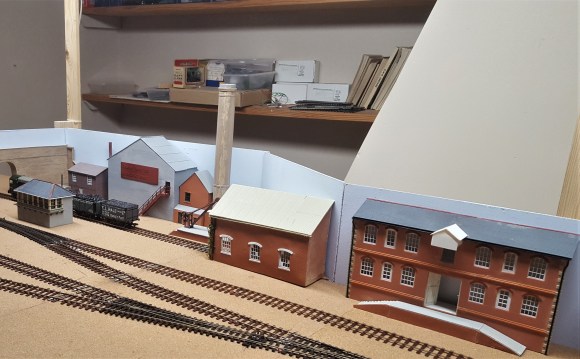
Now coming up to date, Grahams wife has sadly got worse and he is still troubled with mobility. Not a good situation, but to make life a little more bearable he has started on a new layout – Ollands Sidings, this all at the age of 86!
Not only is it a new layout, its DCC Sound and diesel traction. Graham was always a master craftsman when it came to scratch building houses etc. and this layout is no different. It is early stages but he has made great progress and it is looking great.
I will keep posting on this site as the layout progresses. This will be the only place you will see what’s happening as this layout will never be exhibited due to reasons already explained. Before showing the first batch of photographs I would like to thank Ian Taylor, Grahams ‘over the road’ neighbour for his help assisting Graham to fulfill his latest Layout.
Please remember all Buildings below are scratch built.
After a substantial wait Model Rail have published Winkles Yard in their latest edition, October 2020. Shaun Harvey, one of our syndicate members has really made a great effort with this OO layout and deserves high praise. I really recommend this article for its informative writing and great photographs of a superb layout.
Sadly due to copyright I can not publish their photos, but believe me you will not be disappointed.
When this Covid 19 pandemic is over, Shaun will be only to pleased to discuss attending Exhibitions with Winkles Yard.
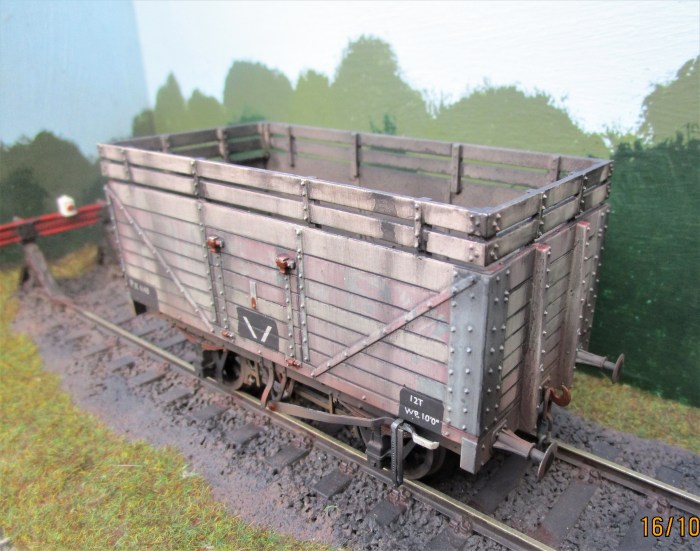
This is the last item in my recent batch of O Gauge Wagons. This was made by Graham and painted and weathered by myself. The windows are still to be added and then the roof attached.